AI & process automation

Business process automation and artificial intelligence

Software takes over the repetitive work. Decisions stay with people.

We design automation and AI solutions that simplify business processes. From OCR and automatic data entry to AI assistants, we integrate documents, applications and business systems to cut repetitive tasks, errors and lead times. We also build Private AI solutions on dedicated infrastructure, with close attention to data security and confidentiality.

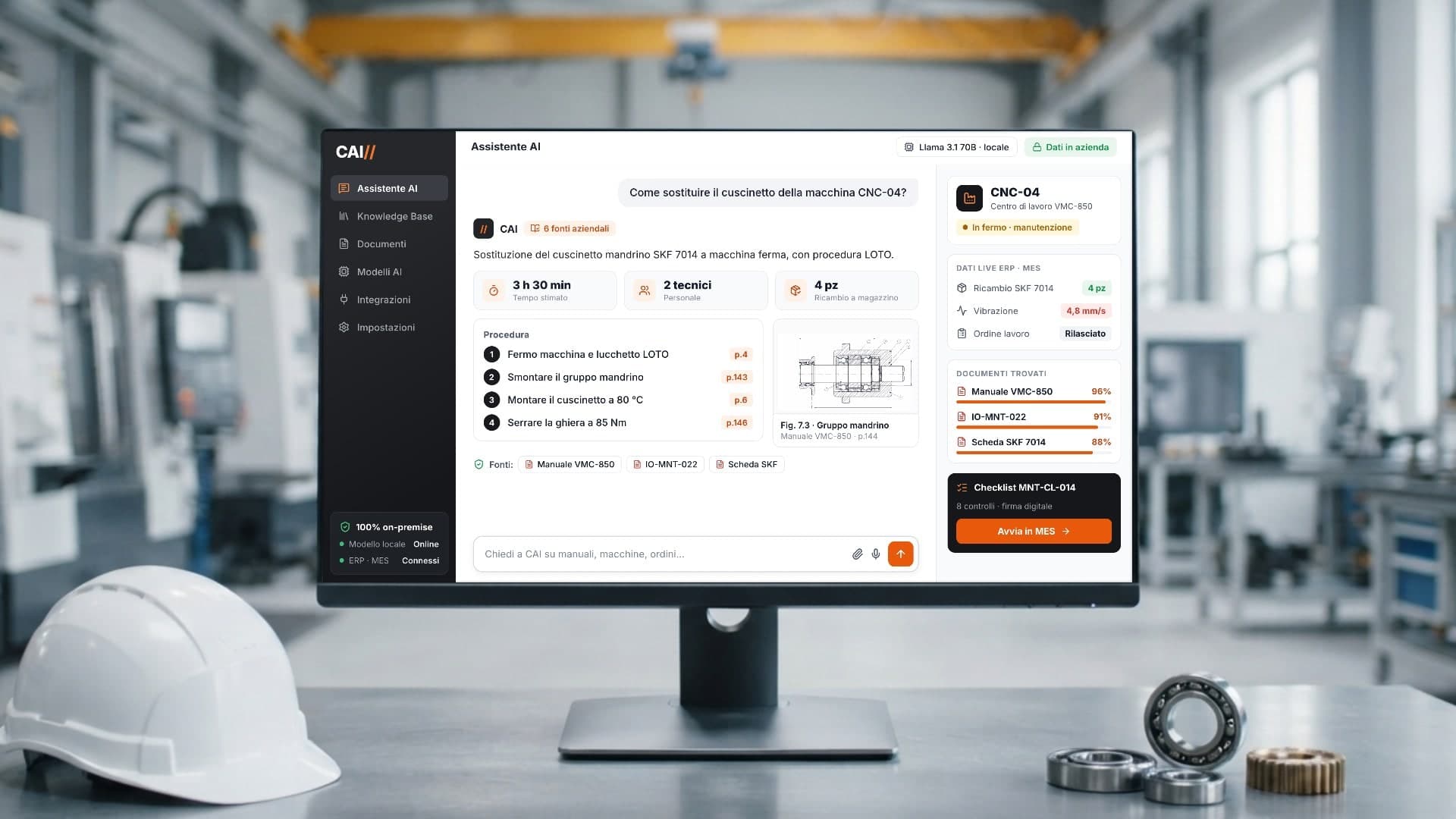
Business AI assistant on a monitor in a factory: it answers with the procedure and the sources from the manuals
CAI, the business AI platform built by digitalH.

Every day, the same steps. Every day, the same time lost.

An order arrives by email. Someone opens the attachment, checks the information, types it into the business software and updates other systems by hand.

Much of this can be automated.

We analyse your processes and build solutions that capture information, run checks, update applications and coordinate work, leaving people the decisions and checks that need attention.

We automate what slows your company down.

Smart OCR and automatic data entry

We automatically capture, read and process orders, delivery notes, invoices, contracts and other business documents. We combine OCR, AI and validation rules to extract information and record it in your business systems, reducing manual entry.

Process automation and workflows

We connect applications, departments and tasks through automated workflows. From requests and approvals to data sync, we make processes more efficient, traceable and organised.

Business AI assistants

We build smart assistants integrated with documents, procedures, databases and business systems. With AI and RAG, we make it easier to find information, support operations and reach internal knowledge.

Private AI and on-premise solutions

We build private AI on company servers and dedicated cloud infrastructure: local models, AI assistants and RAG systems with access control, information protection and data handling that match your security and confidentiality needs.

From PDF orders to your business software

A customer sends an order by email. Your sales team opens the PDF and copies product codes, quantities and delivery dates into your business software by hand. We can automate this step, starting from the documents you receive and the rules of your ERP.

For example, if a line in the order has a product code your business software does not recognise, the system can alert the person who follows the order. During the analysis we decide together which data is recorded automatically and which needs a confirmation.

  1. 01

    Capture

    Documents and requests arrive from email, portals or business applications.

  2. 02

    Processing

    OCR and AI extract, interpret and classify the information.

  3. 03

    Validation

    The system checks the data, flags anomalies and asks for approval when needed.

  4. 04

    Integration

    Validated information is sent to ERP, CRM or other applications.

  5. 05

    Automation

    The workflow updates statuses, sends notifications and starts the next tasks.

Concrete applications in business processes.

Technician in a factory checking a procedure on a tablet
Boutique back office: a garment photographed with a smartphone for the product page
Finance and accounting
Capturing invoices and documents, data extraction, preliminary checks and approvals.
Purchasing and suppliers
Reading orders, matching documents, updating information and managing communication.
Sales and customer care
Classifying email, handling requests, updating the CRM and supporting operators.
Production and logistics
Processing orders and delivery notes, consulting procedures, updating statuses and syncing systems.
Knowledge management
AI assistants to consult documents, manuals, procedures and internal information, also on private infrastructure.
AI has to integrate with your systems. And respect your data.

You don’t need another isolated piece of software. We design automation that works with the ERP, CRM, databases, document platforms and applications you already use.

We choose cloud, hybrid or private architectures based on operational needs and security requirements. Where needed, we add access control, encryption, traceability, human oversight and technical measures that support GDPR alignment and the applicable AI Act requirements.

Private AI. Your artificial intelligence, under your control.

  • Users
  • ERP / CRM
  • Documents
Authorised connections

Private infrastructure

On-premise or private cloud

  • Local AI models
  • RAG and knowledge base
  • API gateway
  • Roles and audit log
  • On-premise AI

    Models running on local servers, without sending requests to external AI services.

  • Private cloud AI

    Dedicated environments with isolated resources and controlled access.

  • Business AI with RAG

    Assistants that retrieve information only from authorised sources.

  • Hybrid AI

    Local models and cloud services, deciding which data may leave.

Illustrative diagram of a private architecture with no calls to external AI models.

GDPR and AI Act

We design AI solutions with GDPR principles and the applicable AI Act requirements in mind: architecture, data protection, access control, traceability, human oversight and technical documentation, working with your privacy, compliance and security leads.

The GDPR applies when personal data is processed. The AI Act sets different obligations depending on the organisation’s role and the type of AI system, with staggered deadlines. European Commission AI Act Service Desk

Grants and incentives

Your digital investment may qualify for incentives.

  • SME digitalisation grants
  • I4.0 digital vouchers
  • Industry 4.0
  • Transition 5.0
  • EU ERDF funds

We assess with you the opportunities available for your project: national and regional digitalisation grants and Italy’s enhanced depreciation (iperammortamento) for eligible investments made from 1 January 2026 to 30 September 2028.

We start from the process, not the technology.

  1. 01

    Analysis and consulting

    We study your processes, find repetitive tasks and assess automation opportunities.

  2. 02

    Design

    We define workflows, integrations, AI technologies and security requirements.

  3. 03

    Development and integration

    We build custom automation and connect it to your business systems.

  4. 04

    Testing and optimisation

    We test on real cases, monitor results and improve the solution step by step.

Frequently asked questions

Which business processes can be automated with AI?

AI can automate or support tasks such as reading documents, entering data, classifying email, handling requests and finding information. Integrated with workflows and business systems, it helps reduce manual work and keep processes running smoothly.

What is the difference between OCR and automatic data entry?

OCR, together with dedicated AI models, recognises text and data in documents, scans, photos, tables, labels and technical drawings, such as title blocks, dimensions and bills of materials. Automatic data entry uses the extracted information, processed and validated with AI where needed, to fill in fields and record data in business systems.

Can AI be integrated with existing ERP and CRM?

Yes, when the systems allow proper integration or the database is accessible. Through APIs, connectors, direct database access and dedicated procedures, automation and AI components can connect to your business software without necessarily replacing it.

What is a business RAG system?

RAG (Retrieval-Augmented Generation) means the assistant searches authorised company documents, such as manuals, procedures and contracts, before answering, and can show the sources it used. Answers are based on your content, not only on the model’s general knowledge, which reduces the risk of hallucinations and inaccurate answers.

Can AI be used without sending data to public AI services?

Yes. With Private AI, local models and on-premise architectures, data and documents can be processed inside the company infrastructure without sending them to external AI services, if every component is configured to run locally.

What is the difference between on-premise AI and private cloud AI?

With on-premise AI the models run on servers installed at your company. With a private cloud they run in a dedicated environment at a provider, with isolated resources and controlled access. The choice depends on the type of data, volumes, in-house skills and budget.

Can AI solutions meet the GDPR and the AI Act?

Yes, they can be designed with the applicable requirements in mind. Compliance, however, depends on the system, the data processed, the purposes and the technical and organisational measures adopted. Private AI does not guarantee compliance by itself.

How much does automating a business process cost?

It depends on task complexity, data volume, required integrations and infrastructure. A preliminary analysis identifies priority automations and estimates investment and running costs.

How much time does your company spend on work that could be automated?

From document management to AI assistants, we build solutions integrated into your processes to cut repetitive work and improve efficiency.